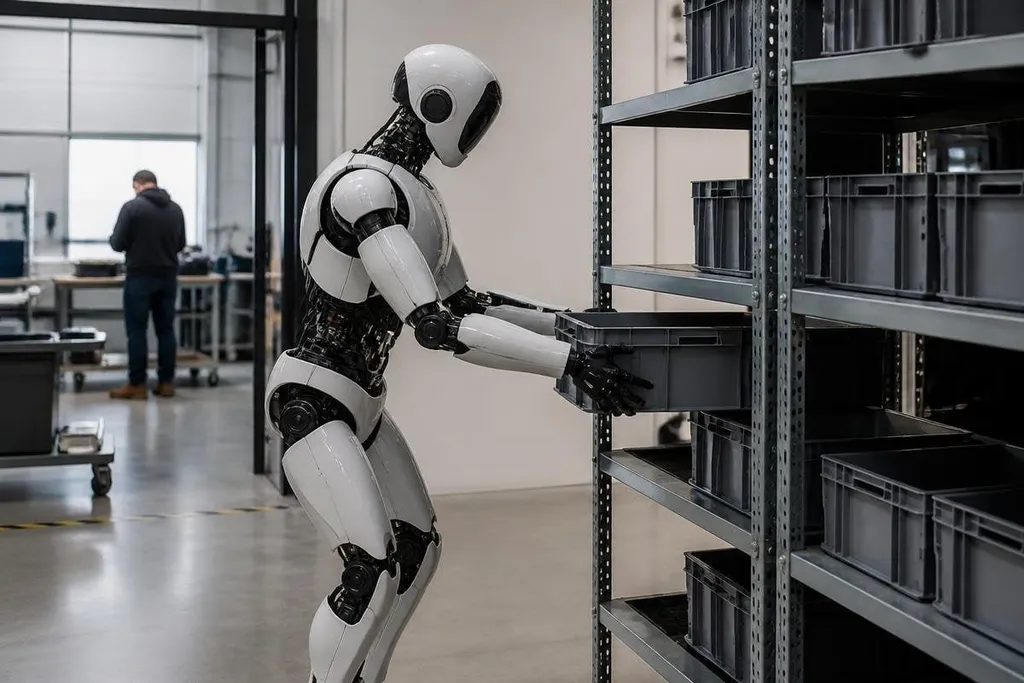
Humanoid robots can use tools, shelves, doors, and work areas built for people. That shape may cut the need to rebuild a site, but it also brings more motors, sensors, software, and ways to fail.
Quick read
- Human-shaped hardware may fit spaces made for people.
- Walking, balance, hand control, and battery life make the work harder.
- A safe trial needs one clear task, human oversight, and a way to stop the robot.
Where the shape helps
A human-shaped robot can reach shelves, handles, switches, and workbenches without needing every part of a building changed. An arm with several joints can reach around an object, while a hand with movable fingers can hold tools or parts made for human use.
That fit matters most in places where a full redesign would cost too much or stop work for too long. A robot that can move through existing doors and aisles may also take on tasks in more than one area, though each task still needs its own safety checks.
The shape does not make a robot useful by itself. A humanoid robot still needs enough reach, payload, balance, and control for the work in front of it. A hand that looks like a person’s hand may still struggle with a loose cable, a soft package, or a tool that needs a firm grip.
What the robot has to control
Walking is a hard robotics problem because the robot must keep its center of mass over its feet as it moves. Sensors measure body position and contact with the floor, then software adjusts the motors many times during each step.
Hands add another layer. The robot must find an object, choose a grip, control force, and release the object at the right point. A small mistake can crush a part, drop a load, or send a tool in the wrong direction.
Battery use also shapes the work. Motors in the legs and arms need energy even when the robot moves slowly. A trial that works for a short shift may not make sense if charging takes the robot away from the task for too long.
A humanoid robot that spends part of a shift charging can leave a person covering its task. Robot 24 can document the battery claim, shift length, and work site, so you can see whether the machine cuts staff work or adds a charging duty. That concern leads into the risks people need to plan for.
The risks people need to plan for
A heavy robot with moving joints can hurt someone if its software loses track of a person or an object. The risk grows when the robot shares space with workers, handles sharp tools, lifts loads, or works near moving vehicles.
Software faults create another problem. A camera may miss a person, a sensor may return bad data, or a network link may fail during a task. The robot needs a physical stop, clear operating limits, and a safe state after a fault.
People can also misread a humanoid robot’s ability. A smooth demonstration may show a narrow task in a prepared space. It may not show recovery after a blocked path, a changed object, poor lighting, or a person entering the work area.
The data raises a separate concern. Cameras and microphones may record workers or visitors, so an operator needs clear rules for storage, access, and deletion. A robot that handles workplace data needs the same care as any other connected system.
What a useful trial looks like
A good trial starts with one task that has a clear result. The team should record how often the robot finishes the task, how often a person has to step in, how much energy it uses, and what happens when the task fails.
That record matters more than a polished video. It shows whether the robot can repeat the work under normal conditions, not only when an engineer prepares every object and watches every move.
I'd skip a humanoid pilot that can't state the task, stop rules, and success measure before the robot enters the work area.
A practical buying checklist
Use these checks before paying for a humanoid robot trial:
- Name one task: Write down the object, movement, finish point, and expected work rate.
- Check the space: Measure doors, floor changes, shelf height, lighting, and worker paths.
- Set the safety plan: Mark stop buttons, restricted areas, handover rules, and fault actions.
- Record human help: Count every remote command, manual reset, object adjustment, and pause.
- Test failure cases: Try blocked routes, changed objects, low light, and a lost network link.
- Price the whole system: Add charging, training, maintenance, software, guarding, and staff time.
The strongest use case will be a repeated task in a human-built area where the robot can work at a safe distance and people can take over when needed.
The open question is whether each robot can repeat that task for long enough, with few enough interventions, to justify its full operating cost.